
Introduction
Imagine enjoying your favourite meal without worrying about loose dentures or missing teeth. For many patients, this is a major goal.
Losing several teeth can affect much more than your smile.
It can make chewing difficult, change your speech, and reduce confidence in everyday situations.
Fortunately, modern implant dentistry offers several options for replacing an entire arch of teeth.
Patients researching full mouth dental implants dubai commonly encounter three treatment approaches: All-on-4, All-on-6, and zygomatic implants.
Although these treatments share the goal of restoring missing teeth, they are not interchangeable.
Each approach uses different implant configurations and depends on your jawbone, oral health, and treatment requirements.
The full mouth dental implants cost in dubai also varies considerably between these options.
Some patients qualify for conventional implant-supported bridges, while others need specialised solutions for significant bone loss.
This guide explains how each treatment works, who may qualify, the expected costs, and important questions to ask.
Understanding these differences helps you make an informed decision before beginning treatment.
What Are Full Mouth Dental Implants?
Full-mouth dental implants replace an entire arch or both arches of missing or failing teeth.
Unlike conventional dentures, implant-supported restorations receive support from implants placed within the jawbone.
The implants act as artificial tooth roots.
They support a fixed bridge or, in some cases, a removable implant-retained denture.
Treatment aims to restore:
- Chewing ability
- Smile appearance
- Speech
- Dental stability
- Everyday comfort
The number of implants depends on the treatment design and individual anatomy.
Why Does the Implant System Matter?
Different patients have different amounts of supporting jawbone.
Some have enough bone for conventional implant placement.
Others experience substantial bone loss following long-term tooth loss or periodontal disease.
The choice of implant system depends on:
- Available bone
- Upper or lower jaw anatomy
- Gum health
- General health
- Bite forces
- Existing teeth
- Restoration design
- Treatment goals
This is why the same treatment does not suit every patient.
What Are All-on-4 Dental Implants?
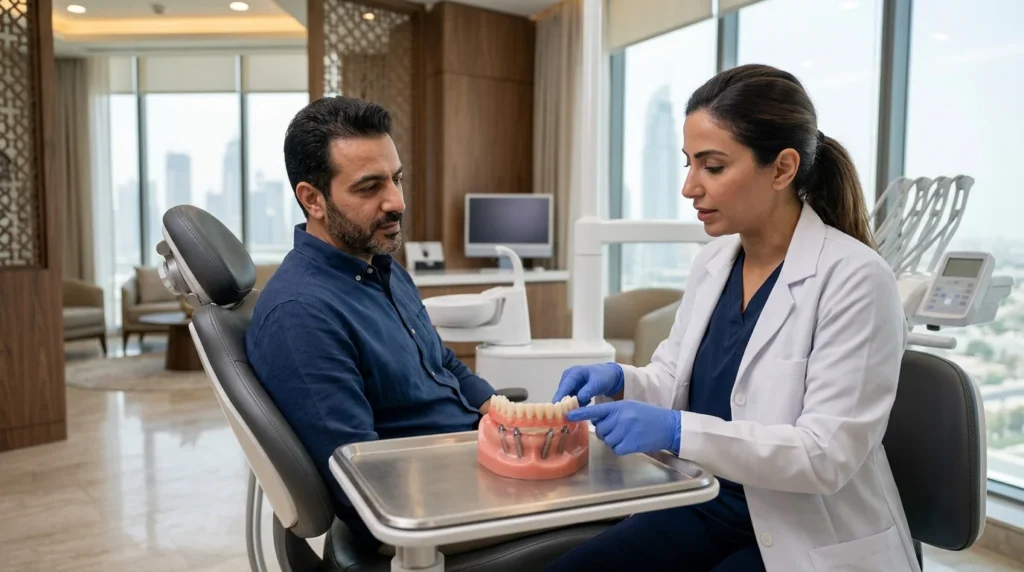
All on 4 dental implants support a full-arch fixed restoration using four implants.
Typically, two implants sit towards the front of the jaw.
The remaining two may be angled towards the back.
This arrangement helps make use of available bone.
Benefits of All-on-4
Potential advantages include:
- Full-arch restoration with four implants
- Fixed teeth rather than conventional removable dentures
- Reduced need for bone grafting in selected patients
- Improved chewing stability
- Possibility of immediate temporary teeth when clinically appropriate
However, immediate temporary teeth are not suitable for every patient.
Final restoration timing depends on healing and implant stability.
Who Is a Good Candidate for All-on-4?
All-on-4 may suit patients who:
- Have multiple missing or failing teeth
- Need full-arch rehabilitation
- Have suitable supporting bone
- Want a fixed restoration
- Meet the medical requirements for implant surgery
A detailed assessment determines whether four implants provide adequate support.
What Are All-on-6 Dental Implants?
Patients researching all on 6 implants dubai are exploring full-arch restoration supported by six implants.
The approach distributes support across six implant positions.
This can provide additional restorative flexibility in selected cases.
Benefits of All-on-6
Potential advantages include:
- Support from six implants
- More implant positions for distributing chewing forces
- Additional prosthetic design options
- Fixed full-arch tooth replacement
- Possible advantages in selected anatomical situations
However, six implants are not automatically better than four.
The optimal number depends on bone availability, implant positioning, restoration design, and clinical planning.
Who Is a Good Candidate for All-on-6?
All-on-6 may suit patients with:
- Adequate jawbone volume
- Suitable bone distribution
- Full-arch tooth loss
- A need for fixed rehabilitation
- Clinical circumstances supporting six implant placements
Patients with insufficient bone may require additional procedures or alternative treatment plans.
What Are Zygomatic Dental Implants?
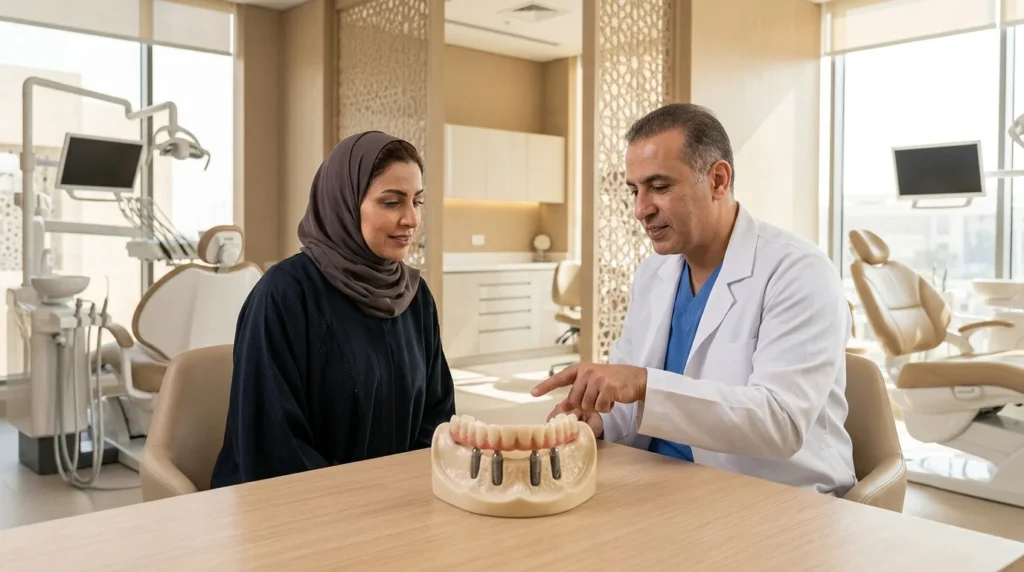
Zygomatic dental implants are specialised implants that obtain support from the cheekbone.
They are primarily used in selected patients with severe upper-jaw bone loss.
Conventional implants usually depend on sufficient bone within the jaw.
Zygomatic implants use a different anchoring approach.
Their placement requires advanced surgical planning and expertise.
Who May Need Zygomatic Implants?
Zygomatic implants may be considered for patients with:
- Severe upper-jaw bone loss
- Unsuitable bone for conventional implants
- Certain previous implant treatment failures
- Complex upper-jaw rehabilitation needs
- Anatomical limitations affecting conventional implant placement
They may reduce the need for extensive bone grafting in selected cases.
However, they are not appropriate for every patient.
Are Zygomatic Implants Better Than All-on-4?
Not necessarily.
These treatments address different anatomical situations.
All-on-4 commonly uses implants supported by the jawbone.
Zygomatic implants obtain support from the cheekbone when conventional upper-jaw support is insufficient.
Zygomatic treatment can also involve greater surgical complexity.
The choice depends on clinical necessity rather than preference alone.
All-on-4 vs All-on-6 vs Zygomatic Implants
| Feature | All-on-4 | All-on-6 | Zygomatic |
| Typical support | Four implants | Six implants | Zygomatic implants, sometimes combined with conventional implants |
| Main bone support | Jawbone | Jawbone | Cheekbone |
| Common use | Full-arch restoration | Full-arch restoration | Severe upper-jaw bone loss |
| Bone requirements | Suitable jawbone | Suitable jawbone | Alternative support for selected upper-jaw cases |
| Surgical complexity | Case-dependent | Case-dependent | Usually more complex |
| Fixed teeth possible | Yes | Yes | Yes |
| Suitable for lower jaw | Yes | Yes | No, zygomatic anchorage is an upper-jaw technique |
The final treatment plan depends on clinical examination and imaging.
Full Mouth Dental Implants Cost in Dubai
Cost is one of the most important considerations for patients.
However, there is no single standard price for full-mouth rehabilitation.
The total depends on the implant system, surgical complexity, restoration materials, and additional treatment requirements.
Illustrative Dubai Market Cost Ranges
The following figures are broad budgeting estimates, not confirmed fees from Dr. Gagan Sabharwal’s practice.
| Treatment | Illustrative cost per arch |
| All-on-4 | AED 25,000–50,000+ |
| All-on-6 | AED 30,000–65,000+ |
| Zygomatic implant rehabilitation | AED 45,000–90,000+ |
These figures are not verified current quotations and may differ substantially between providers.
Complex cases, premium restorations, and additional procedures can increase the total.
For treatment involving both arches, costs may be considerably higher.
What Affects Full Teeth Replacement Cost?
The full teeth replacement cost depends on several factors.
1. Number and Type of Implants
Different implant configurations involve different surgical and component requirements.
2. Jawbone Condition
Patients with substantial bone loss may require more complex treatment.
3. Tooth Extractions
Remaining teeth may require removal before rehabilitation.
4. Temporary and Final Teeth
Temporary restorations and final prostheses may have separate costs.
5. Restoration Materials
Material selection affects durability, appearance, repair options, and price.
Examples include zirconia and other dental prosthetic materials.
6. Diagnostic Imaging
Three-dimensional imaging may be required for surgical planning.
7. Surgical Complexity
Advanced procedures can require additional resources and specialist expertise.
Are There Alternatives to Fixed Full-Mouth Implants?
Yes.
Not every patient needs a fixed full-arch bridge.
Some prefer a removable implant-supported restoration.
What Is an Implant Overdenture?
An implant overdenture is a removable denture supported or retained by dental implants.
It offers more stability than many conventional dentures.
Patients researching implant overdenture in dubai may find it a suitable alternative to fixed implant bridges.
Potential Benefits
- Improved denture retention
- Easier removal for cleaning
- Different maintenance requirements
- Potentially lower costs than certain fixed solutions
- Improved comfort compared with poorly fitting conventional dentures
However, implant overdentures still require regular cleaning and professional maintenance.
They are not identical to fixed full-arch bridges.
How Does the Treatment Process Work?
Step 1: Consultation
Your surgeon reviews your dental history, symptoms, and treatment expectations.
Step 2: Clinical Examination
The examination assesses your gums, existing teeth, bite, and jaw anatomy.
Step 3: Imaging and Planning
Dental X-rays and CBCT imaging may help evaluate bone volume and important anatomical structures.
Step 4: Treatment Selection
Your clinician recommends an appropriate implant configuration based on your condition.
Step 5: Implant Placement
The implants are surgically positioned according to the treatment plan.
Step 6: Temporary Restoration
Some patients qualify for temporary fixed teeth shortly after surgery.
Others require a different healing approach.
Step 7: Final Restoration
The definitive prosthesis is provided according to the treatment and healing plan.
Step 8: Maintenance
Regular cleaning and professional reviews help protect the implants and surrounding tissues.
Does Technology Improve Implant Planning?
Modern implant treatment often uses digital planning tools.
Cone-beam computed tomography, commonly called CBCT, provides three-dimensional views of jaw anatomy.
Digital planning can help clinicians assess:
- Bone availability
- Implant positions
- Nearby nerves
- Sinus anatomy
- Prosthetic requirements
Some practices use guided or navigation-assisted implant placement.
Systems such as X-Guide support real-time navigation during selected implant procedures.
However, technology does not replace clinical judgement or guarantee successful treatment.
A Simple Patient Example
Consider two patients seeking full-mouth rehabilitation in Dubai.
Patient A: Suitable Jawbone
The first patient has multiple failing teeth but adequate supporting bone.
Following assessment, a conventional full-arch implant solution may be appropriate.
All-on-4 or All-on-6 can be considered depending on the treatment plan.
Patient B: Severe Upper-Jaw Bone Loss
The second patient has significant bone loss in the upper jaw.
Conventional implants may not provide suitable support without additional procedures.
Zygomatic implants may become an option after specialist evaluation.
These examples demonstrate why treatment selection depends on anatomy rather than advertising claims.
What Are the Risks of Full-Mouth Dental Implants?
All implant procedures involve potential risks.
These include:
- Infection
- Bleeding
- Implant failure
- Nerve injury
- Sinus-related complications
- Gum inflammation
- Prosthetic complications
Zygomatic implants have additional anatomical considerations, including sinus-related risks.
A specialist consultation should explain the risks relevant to your treatment.
Why Consult Dr. Gagan Sabharwal?
Dr. Gagan Sabharwal is an Oral and Maxillofacial Surgeon with more than 20 years of experience.
His professional training includes a Fellowship in Oral Implantology from Italy.
His Dubai practice includes dental implant treatment and related surgical procedures.
Complex implant cases require careful assessment of jawbone anatomy, supporting tissues, and restorative requirements.
Patients considering full-arch rehabilitation benefit from understanding which treatment options suit their individual condition.
A specialist consultation can help determine whether conventional implants, additional bone procedures, or another rehabilitation approach is appropriate.
Conclusion
Choosing between All-on-4, All-on-6, and zygomatic implants requires more than comparing implant numbers or prices.
Each treatment serves different clinical needs.
All-on-4 and All-on-6 provide fixed full-arch rehabilitation using implants supported by suitable jawbone.
Zygomatic implants offer an alternative for selected patients with severe upper-jaw bone loss.
Removable implant overdentures also remain an option for some patients.
The right treatment depends on your bone condition, oral health, restoration goals, and medical history.
If you are researching full mouth dental implants dubai, begin with a detailed assessment rather than choosing a procedure based on price alone.
Book a consultation with Dr. Gagan Sabharwal in Dubai to discuss your tooth replacement needs, understand suitable implant options, and receive an individual treatment assessment.
