
What happens when several or all your teeth are missing, damaged, or no longer acceptable for predictable restoration?
Replacing every tooth individually is not always necessary.
Full Mouth Dental Implants Dubai can use strategically positioned implants to support a complete set of replacement teeth.
One well-known approach is All-on-4 Dental Implants, where four implants support a full-arch fixed restoration in suitable patients.
However, full-mouth treatment is not one standard procedure for everyone.
Your bone condition, remaining teeth, bite, general health, and treatment goals determine the most appropriate approach.
Hence, the process starts long before implant surgery.
Detailed examination and 3D imaging help your Dental Implant Specialist Dubai understand your anatomy and plan the implant positions.
Some patients also require extractions, bone grafting, or other preparatory treatment.
This blog walks you through the full-mouth implant procedure step by step.
You learn:
- What full-mouth implants are
- Who may benefit from them
- How All-on-4 works
- What happens during each treatment stage
- What recovery involves
- How the final teeth are fitted
Understanding the process can make a major dental procedure feel much more manageable.
What Are Full-Mouth Dental Implants?
Full-mouth implant treatment replaces an entire upper arch, lower arch, or both arches of missing teeth.
Several implants support a complete dental restoration.
Unlike traditional removable dentures, fixed implant-supported teeth connect securely to implants within the jaw.
Treatment can involve different implant numbers and configurations.
The right approach depends on your individual anatomy.
What Are All-on-4 Dental Implants?
All-on-4 Dental Implants utilise four strategically positioned implants to support a complete fixed arch of replacement teeth.
Typically, implants are positioned to make effective use of the available bone.
This approach can reduce the need for extensive grafting in some suitable patients.
However, All-on-4 is not automatically the best treatment for every full-mouth case.
Some patients require additional implants or alternative techniques.
Why Consider Full-Mouth Dental Implants?
Living with extensive tooth loss can affect everyday activities.
Patients may struggle with:
- Chewing certain foods
- Speaking confidently
- Loose dentures
- Facial appearance
- Social confidence
Full-mouth implant treatment’s goal is to restore stable teeth and comfortable oral function.
Benefits of Full-Mouth Implant Treatment
1. Greater Stability
Implant-supported teeth connect securely to implants.
They do not depend solely on the gums for support.
2. Improved Chewing
Stable replacement teeth can make eating more comfortable.
Patients still need to follow dietary instructions during healing.
3. Natural Appearance
The restoration is designed around the patient’s smile, facial features, and bite.
4. Improved Confidence
Stable teeth can make speaking, smiling, and socialising feel more comfortable.
5. Full-Arch Replacement
A meticulously planned implant configuration can support an entire arch.
This means every missing tooth does not necessarily require its own implant.
Step-by-Step Full-Mouth Dental Implant Procedure
Full-mouth treatment involves several carefully planned stages.
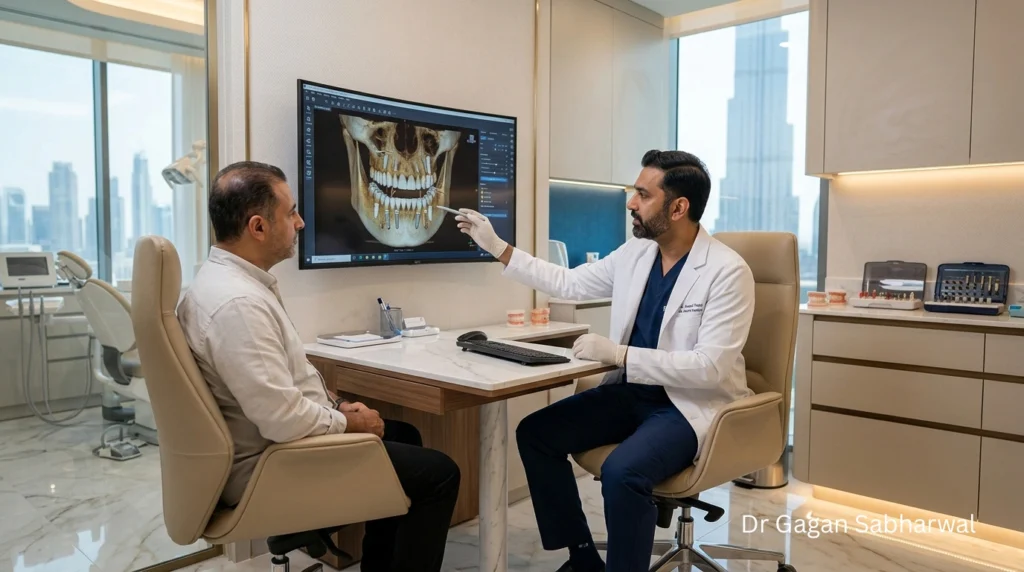
Step 1: Specialist Consultation
Treatment starts with a detailed consultation.
Your surgeon assesses:
- Remaining teeth
- Gum health
- Jawbone
- Bite
- Medical history
- Previous dental treatment
- Expectations
This stage determines whether implant treatment is appropriate.
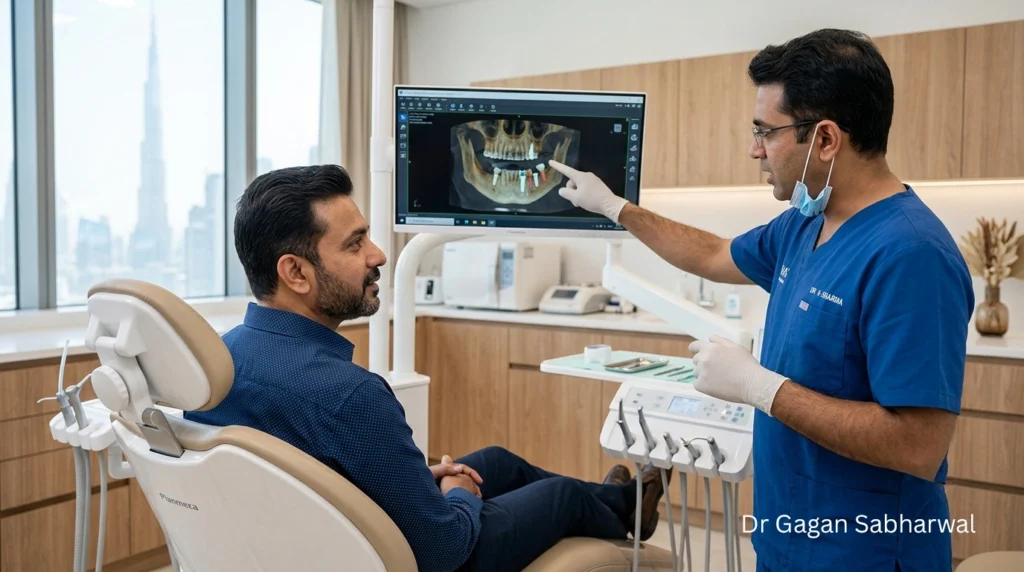
Step 2: 3D Imaging and Digital Planning
Your Dental Implant Clinic Dubai may use CBCT imaging to create a three-dimensional view of your jaws.
This helps evaluate:
- Bone height
- Bone width
- Nerve positions
- Sinus anatomy
- Existing infections
- Potential implant locations
Digital planning helps govern implant position, angle, and depth before surgery begins.
Step 3: Decide Which Teeth Can Stay
Full-mouth implants do not mean every remaining tooth automatically needs removal.
Teeth with a good prognosis may sometimes remain.
Teeth that cannot predictably function may require extraction.
The goal is to preserve healthy structures whenever clinically appropriate.
Step 4: Bone Assessment
Implants require suitable bone support.
Some patients already have sufficient bone.
Others experience bone loss after years of missing teeth, infection, or periodontal disease.
Depending on the case, additional procedures can comprise:
- Bone grafting
- Sinus augmentation
- Ridge augmentation
Dr. Gagan Sabharwal’s practice includes both dental implant treatment and sinus lift and bone grafting procedures.
Step 5: Implant Placement
The next stage involves surgically positioning the implants.
The exact number depends on the treatment plan.
For All-on-4 Dental Implants, four implants assist one full arch.
Other full-mouth approaches may use more implants.
Local anaesthesia helps keep the surgical area comfortable.
Step 6: Check Implant Stability
Implant stability is specifically important when immediate temporary teeth are considered.
Your surgeon evaluates each implant during treatment.
If sufficient stability is present, immediate loading may be possible in selected cases.
If stability is not suitable, allowing additional healing time can provide the safer approach.
Step 7: Temporary Teeth
Suitable patients may receive temporary fixed teeth soon after implant placement.
These temporary teeth restore appearance while healing continues.
They are not necessarily the final permanent restoration.
Your surgeon usually provides distinct instructions about chewing during this stage.
Step 8: Healing and Osseointegration
Healing continues beneath the temporary restoration.
The bone gradually forms a stable connection around the implants.
This biological process is called osseointegration.
You may feel comfortable much quicker, but internal healing still requires time.
Step 9: Final Restoration
Once healing reaches the appropriate stage, planning for the definitive teeth begins.
Your dental team considers:
- Bite
- Tooth shape
- Tooth position
- Smile appearance
- Speech
- Comfort
The final full-arch restoration then bridges the implants.
Step 10: Maintenance
Treatment does not finish when the final teeth arrive.
Implant-supported restorations require lifelong care.
Maintenance includes:
- Daily brushing
- Cleaning underneath the restoration
- Appropriate interdental cleaning
- Professional implant reviews
- Monitoring gum health
- Checking the bite and restoration
Long-term success depends partially on consistent maintenance.
How Long Does the Full Procedure Take?
There is no universal timeline.
Some patients receive temporary fixed teeth shortly after surgery.
The definitive restoration usually follows after appropriate healing.
Treatment takes longer when additional procedures are needed.
Examples include bone grafting, infection management, or more complex reconstruction.
Your individual treatment plan provides the most useful timeline.
Who Is a Good Candidate?
You may be considered for Full Mouth Dental Implants Dubai when you have extensive tooth loss or failing teeth.
Other important considerations include:
- Suitable general health
- Manageable gum disease
- Appropriate bone conditions
- Good oral hygiene
- Realistic expectations
- Commitment to maintenance
Bone loss does not automatically avert implant treatment.
Specialist assessment determines whether grafting or another implant approach is appropriate.
A Simple Patient Example
Consider a patient who struggles with a loose lower denture.
Eating becomes uncomfortable, and the denture moves while speaking.
3D imaging shows suitable bone for full-arch implant treatment.
After detailed planning, strategically positioned implants provide support for a fixed restoration.
The patient obtains temporary teeth during healing and later progresses to the definitive restoration.
Another patient with significant bone loss may require a different treatment sequence.
This is why full-mouth implant treatment needs personalised planning.
What Does Research Say About All-on-4?
Research supports full-arch implant rehabilitation as a predictable option for appropriately selected patients.
A recent review reports cumulative survival rates between 94.8% and 99.3% across systematic reviews examining All-on-4 treatment.
However, researchers also highlight limitations in the quality of some available proof.
Long-term success therefore depends on more than choosing a particular technique.
Good diagnosis, surgical planning, restoration design, risk assessment, and ongoing maintenance all matter.
Why Consult Dr. Gagan Sabharwal?
Full-mouth implant treatment blends surgical planning, bone assessment, implant placement, and long-term restorative considerations.
Dr. Gagan Sabharwal is a Specialist Oral and Maxillofacial Surgeon with more than 20 years of experience.
His international training includes a Fellowship in Oral Implantology from Italy.
His practice provides dental implant treatment alongside sinus lift and bone grafting surgery for patients with more complex surgical requirements.
This specialist background is particularly pertinent when full-mouth rehabilitation involves bone loss, multiple extractions, or advanced implant planning.
Conclusion
Full Mouth Dental Implants Dubai involve much more than placing several implants and attaching new teeth.
Successful treatment starts with detailed examination, 3D imaging, bone assessment, and personalised surgical planning.
Procedures such as All-on-4 Dental Implants can support an entire arch using strategically positioned implants in suitable patients.
However, the best implant configuration varies from person to person.
Temporary teeth, healing, final restoration, and ongoing maintenance all form important parts of the process.
If you have extensive missing or failing teeth, start with a specialist assessment rather than opting for a treatment from an advertisement.

