
A wisdom tooth can sit quietly for years. Then pain, swelling, or difficulty opening your mouth suddenly makes it impossible to ignore.
This often happens when a wisdom tooth becomes affected.
An impacted tooth does not fully emerge because there is insufficient space or another tooth, bone, or gum blocks its path.
However, Impacted Wisdom Teeth Dubai do not automatically require surgery.
Some remain symptom-free and disease-free. Others contribute to infection, decay, gum problems, cysts, or damage to nearby teeth.
The decision about Wisdom Tooth Removal UAE therefore depends on more than simply seeing an impacted tooth on an X-ray.
Its position, symptoms, surrounding tissues, relationship with neighbouring teeth, and proximity to important nerves all matter.
For more complex cases, assessment by an Oral Surgeon Dubai can help determine whether surgery is necessary and how it should be planned.
This blog explains:
- What impacted wisdom teeth are
- Seven warning signs to recognise
- Problems they can cause
- When monitoring may be appropriate
- When surgery becomes necessary
- What happens during removal
Knowing these signs helps you seek care before a manageable problem becomes more complicated.
What Are Impacted Wisdom Teeth?
Wisdom teeth are the third molars at the back of your mouth.
They normally appear during late adolescence or early adulthood.
Sometimes there is not enough space for them to emerge normally.
The tooth may remain completely underneath the gum or only partially emerge.
This is known as impaction.
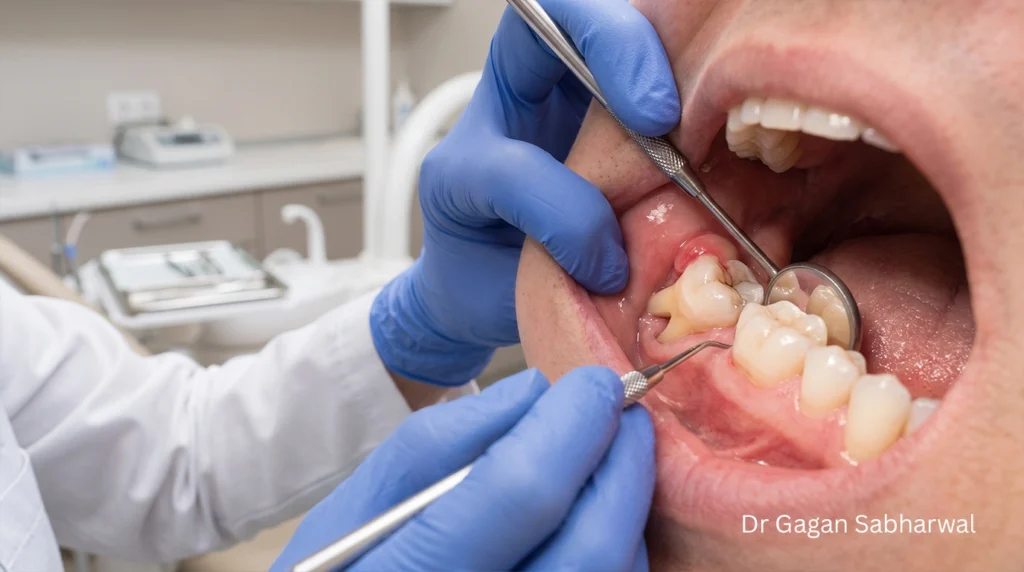
What Are the Different Types of Impaction?
Wisdom teeth do not all become impacted in the same direction.
Common positions can be:
Mesial Impaction
The wisdom tooth tilts towards the tooth in front.
Vertical Impaction
The tooth remains relatively upright but does not fully surface.
Horizontal Impaction
The wisdom tooth lies sideways towards the neighbouring molar.
Distal Impaction
The tooth angles towards the back of the mouth.
The position helps your surgeon understand the complexity of treatment.
7 Signs of Impacted Wisdom Teeth
Some impacted teeth have no symptoms.
Others make their presence very clear.
1. Pain at the Back of Your Mouth
Pain around the final molars is a common warning sign.
It may feel dull, persistent, or worse while chewing.
2. Swollen or Tender Gums
The gum surrounding a partially erupted wisdom tooth can become inflamed.
It may appear red, swollen, or sensitive.
3. Difficulty Opening Your Mouth
Inflammation around a wisdom tooth can make jaw movement agonizing.
Some patients notice difficulty opening their mouth normally.
4. Bad Breath or Unpleasant Taste
Food and bacteria can become trapped around partially erupted wisdom teeth.
This can contribute to persistent bad breath or an unpleasant taste.
5. Swelling Around the Jaw
Infection or inflammation may cause visible swelling around the back of the jaw.
Increasing facial swelling requires prompt professional assessment.
6. Food Keeps Getting Trapped
Partially erupted wisdom teeth can create difficult areas to clean.
Repeated food trapping ups the risk of decay and gum inflammation.
7. Problems With the Tooth Next Door
An impacted wisdom tooth can affect the second molar beside it.
Decay, gum problems, or other damage can sometimes develop around this area.
Why Do Impacted Wisdom Teeth Cause Problems?
The main problem is often access.
A partially erupted tooth can create a small pocket beneath the gum.
Food and bacteria become difficult to remove from this area.
This can accord to inflammation called pericoronitis.
Impacted teeth can also create cleaning difficulties around the neighbouring molar.
What Are the Hazards of Leaving a Problematic Wisdom Tooth?
Not every impacted tooth causes complications.
However, a problematic tooth can contribute to:
- Repeated infection
- Gum inflammation
- Tooth decay
- Damage to the neighbouring molar
- Cyst formation
- Persistent pain
- Difficulty maintaining oral hygiene
This is why symptoms should not simply be managed repeatedly with painkillers without pinpointing the cause.
Does Every Impacted Wisdom Tooth Need Removal?
No.
This is one of the most important facts for patients to understand.
An impacted wisdom tooth that is healthy, symptom-free, and disease-free may not always require immediate surgery.
Professional monitoring may be appropriate in selected cases.
Your clinician considers:
- Symptoms
- Tooth position
- Gum condition
- Decay
- Infection
- Neighbouring teeth
- Cystic changes
- Cleaning difficulty
- Future risk
Regular assessment becomes important when an impacted tooth remains in place.
When Is Wisdom Tooth Surgery Necessary?
Wisdom Tooth Surgery Dubai is commonly considered when the tooth causes or contributes to disease.
Reasons can include:
Repeated Infection
Recurring pericoronitis can cause pain, swelling, and difficulty eating.
Significant Tooth Decay
Wisdom teeth can be immensely difficult to restore when their position limits access.
Damage to the Second Molar
Protecting the neighbouring healthy tooth can become an important reason for treatment.
Cysts or Other Pathology
Impacted teeth can sometimes be associated with cysts or other abnormal changes.
Incessant Pain
Ongoing symptoms require investigation to determine whether the wisdom tooth is responsible.
Gum Disease
Difficult cleaning can contribute to periodontal problems around the wisdom tooth and neighbouring molar.
The decision should always follow proper clinical and radiographic assessment.
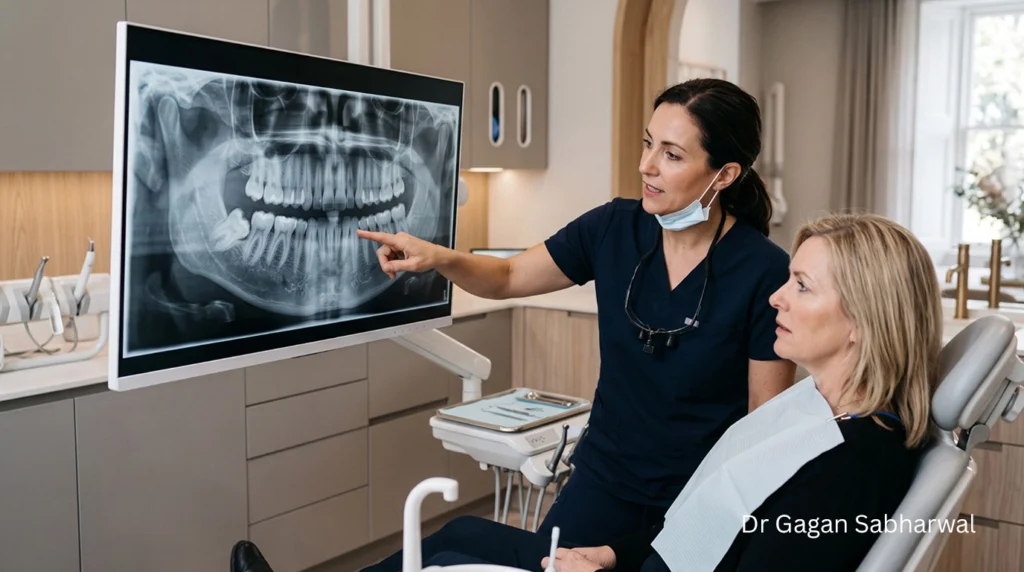
How Does an Oral Surgeon Assess an Impacted Tooth?
Examination usually begins with your symptoms and dental history.
Your surgeon then examines the back of the mouth.
Dental imaging helps reveal what cannot be seen clinically.
It can show:
- Tooth position
- Root shape
- Depth of impaction
- Surrounding bone
- Neighbouring teeth
- Important anatomical structures
Lower wisdom teeth deserve particular attention because their roots can sit close to nerves within the jaw.
Why Does the Nerve Position Matter?
A major nerve runs through the lower jaw.
This nerve provides sensation to areas including the lower lip and chin.
Some lower wisdom tooth roots lie close to this nerve.
Your surgeon evaluates this relationship before surgery.
When conventional dental imaging does not provide enough information, 3D imaging may sometimes assist surgical planning.
This is one reason complex cases profit from specialist assessment.
What Happens During Wisdom Tooth Surgery?
The exact procedure depends on the tooth’s position.
Step 1: Anaesthesia
Local anaesthesia numbs the surgical area.
Additional anaesthesia or sedation options depend on the individual case and treatment setting.
Step 2: Accessing the Tooth
If the tooth remains beneath gum or bone, the surgeon carefully generates access.
Step 3: Removing the Tooth
The tooth may be removed whole or divided into smaller sections.
Sectioning can sometimes allow controlled removal through a smaller surgical area.
Step 4: Cleaning the Area
The extraction site is inspected and cleaned.
Step 5: Closing the Site
Stitches may be placed when required.
Your surgeon then furnishes instructions for the healing period.
What Happens After Wisdom Tooth Removal?
Some swelling and discomfort are expected after surgical removal.
Your surgeon provides instructions based on your individual procedure.
Common advice includes:
- Follow medication instructions carefully
- Avoid disturbing the surgical area
- Choose suitable soft foods initially
- Maintain oral hygiene as instructed
- Avoid smoking
- Attend follow-up appointments when recommended
Contact your surgeon if symptoms become unfamiliar or increasingly severe.
A Simple Patient Example
Consider a patient with a partially erupted lower wisdom tooth.
Food repeatedly becomes confined underneath the surrounding gum.
The patient experiences several episodes of swelling and pain.
Imaging also shows that the tooth’s position makes effective cleaning difficult.
In this situation, removal may offer a more appropriate long-term solution than repeatedly treating the inflammation.
Now consider another patient.
Their wisdom tooth remains fully impacted, causes no symptoms, and shows no signs of disease.
Monitoring may be considered instead.
The word “impacted” alone does not decide the treatment.
When Should You Seek Urgent Attention?
Do not ignore swiftly worsening symptoms.
Seek professional care if you develop:
- Significant facial swelling
- Fever with dental symptoms
- Increasing difficulty opening your mouth
- Difficulty swallowing
- Persistent severe pain
- Pus or significant discharge
- Feeling generally unwell alongside dental swelling
Infection around a wisdom tooth can sometimes spread beyond the immediate tooth area.
Prompt assessment is important.
Why Consult Dr. Gagan Sabharwal?
Impacted wisdom tooth removal can span from straightforward treatment to more complex oral surgery.
Dr. Gagan Sabharwal is an Oral and Maxillofacial Surgeon with more than 20 years of experience.
His practice includes wisdom tooth removal alongside advanced oral and maxillofacial surgical procedures.
Specialist assessment becomes particularly valuable when teeth are deeply impacted, unusually positioned, or close to important anatomical structures.
The aim is not simply to remove every wisdom tooth.
It is to understand whether the tooth presents a genuine problem and determine the appropriate treatment approach.
Conclusion
Impacted Wisdom Teeth Dubai are common, but impaction alone does not automatically mean surgery is necessary.
Some wisdom teeth remain healthy and can be monitored.
Others cause repeated infection, pain, decay, gum disease, cysts, or harm to neighbouring teeth.
Recognising these warning signs helps you seek treatment before complications become more difficult to manage.
If you experience repeated pain, swelling, food trapping, or difficulty opening your mouth, arrange a professional assessment.
For patients considering Wisdom Tooth Removal UAE or Wisdom Tooth Surgery Dubai, specialist evaluation helps determine whether surgery is necessary.

